Two Parts To Create A Connected Whole.
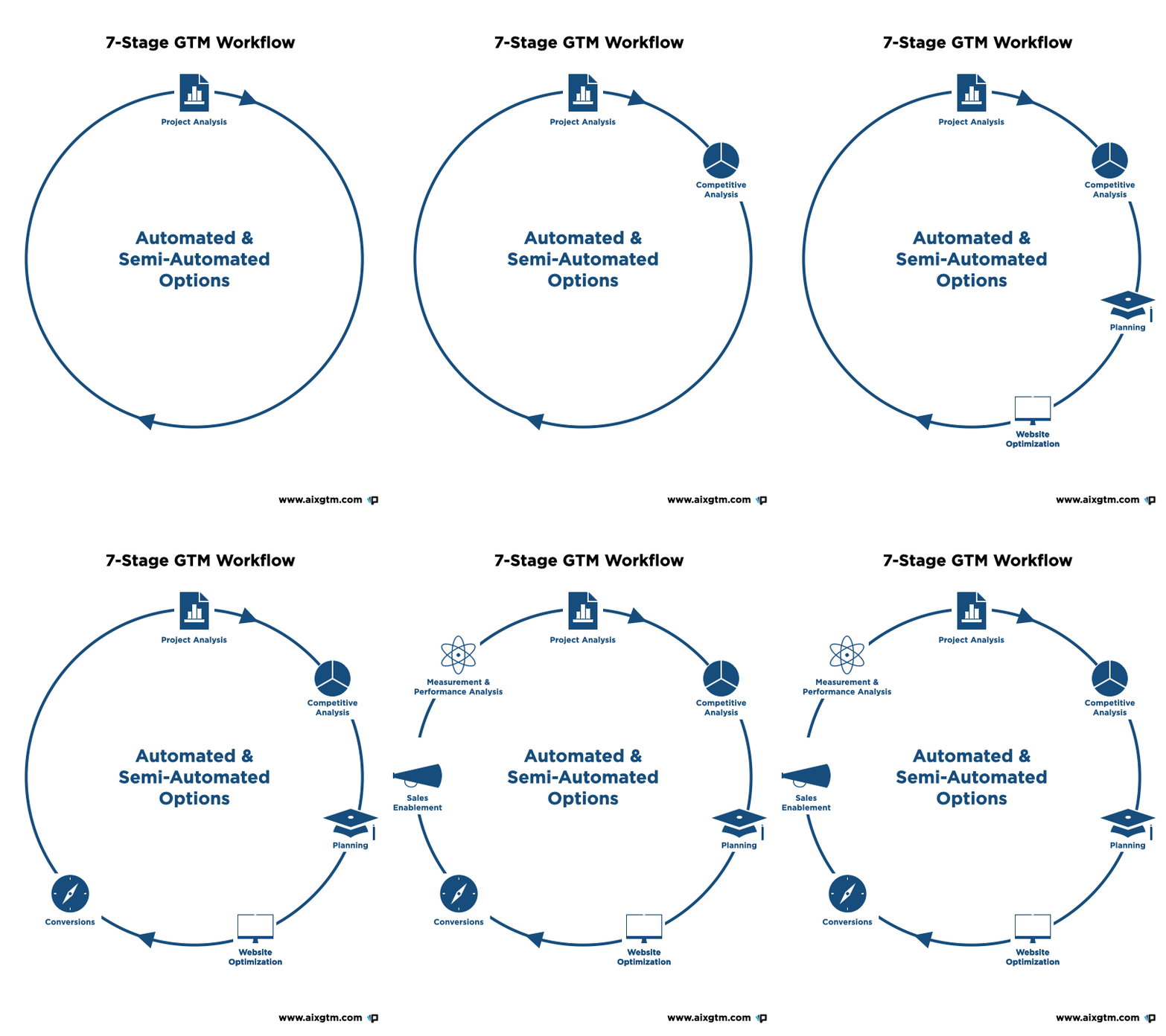
AI x GTM is designed to first build a strong foundation and then methodically add individual marketing layers on top of it. The foundation is built by deeply analyzing project parameters, performance analytics (GA4, Google Ads, etc.), product features and benefits, competitors, and market trends, then augmenting all that with industry, occupation, brand, demographic, psychographic, behavioral traits, and personality-driven preferences to create detailed target audience profiles. Part two is the 7-stage GTM workflow: Project Analysis, Product Analysis, Planning, Website Optimization, Conversions, Sales Enablement, and Measurement. Each stage builds on the previous stage to both add context and ensure context is thoroughly interconnected, so that a sales battle card generated in Sales Enablement inherits the same strategic logic as the marketing plan generated in Planning.
Why Multi-Step Structure Outperforms Single Prompts.
Research on multi-step reasoning in large language models consistently shows that breaking complex tasks into structured stages — with each stage handled by specialized logic — produces better results than single-prompt approaches. Published surveys on multi-step reasoning demonstrate that external orchestration of sequential LLM calls (plan, execute, verify) outperforms monolithic prompting on complex tasks. Meta's Toolformer research shows that delegating specific subtasks to specialized components and composing results yields substantially better accuracy. AI x GTM applies this principle at the workflow level: each stage has specialized prompt logic, tool definitions, and context injection rules. The orchestrator determines what context is needed for each step, dynamically loading the right artifacts at the right time using a three-tier injection strategy — minimal routing context for navigation, stage-specific detail for focused work, and full project context for strategic outputs.
Context Makes the Difference.
Research on prompt specificity shows that giving LLMs more detailed, relevant context significantly improves output quality. Studies demonstrate that moving from vague prompts to detailed, structured prompts improves reasoning accuracy across tasks and models. IBM and Google research on in-context learning shows that providing relevant contextual information in the prompt yields larger performance gains than generic instruction. AI x GTM operationalizes this through dynamic context injection: every prompt receives the full text of your project analysis, product positioning report, marketing plan, and messaging matrix — not as static references, but as live context that shapes every response. This means the quality of your outputs improves as your project context deepens. The more the system knows about your product, audience, and strategy, the more precise every downstream deliverable becomes.
Turn Connected Context Into an Audience-Specific Deck.
Once the marketing plan and messaging matrix are complete, the same connected context can become a Client, Board, or Investor pitch deck. The product, audience, positioning, plan, messaging, and available supporting artifacts stay consistent while the narrative changes for the stakeholder: recommendations and delivery for clients, resources and decisions for boards, or problem, market, differentiation, evidence, and GTM motion for investors. Each deck is available as a polished PDF and editable PowerPoint.