Deep Context
Keep product inputs, audience knowledge, strategic assumptions, and workflow outputs connected so future work starts from context instead of a blank prompt.
Product overview
AI x GTM is a GTM workspace built around connected context — from durable strategy to 90-day operating cycles to this week's briefs and deliverables, with performance evidence feeding back to help you optimize it all.
Keep product inputs, audience knowledge, strategic assumptions, and workflow outputs connected so future work starts from context instead of a blank prompt.
Move from analysis to planning, website refinement, conversions, sales enablement, and iteration through a workflow that preserves the logic behind each deliverable.
Create briefs, messaging, plans, landing pages, content, collateral, audience-specific pitch decks, and progress reporting without rebuilding the strategy for every request.
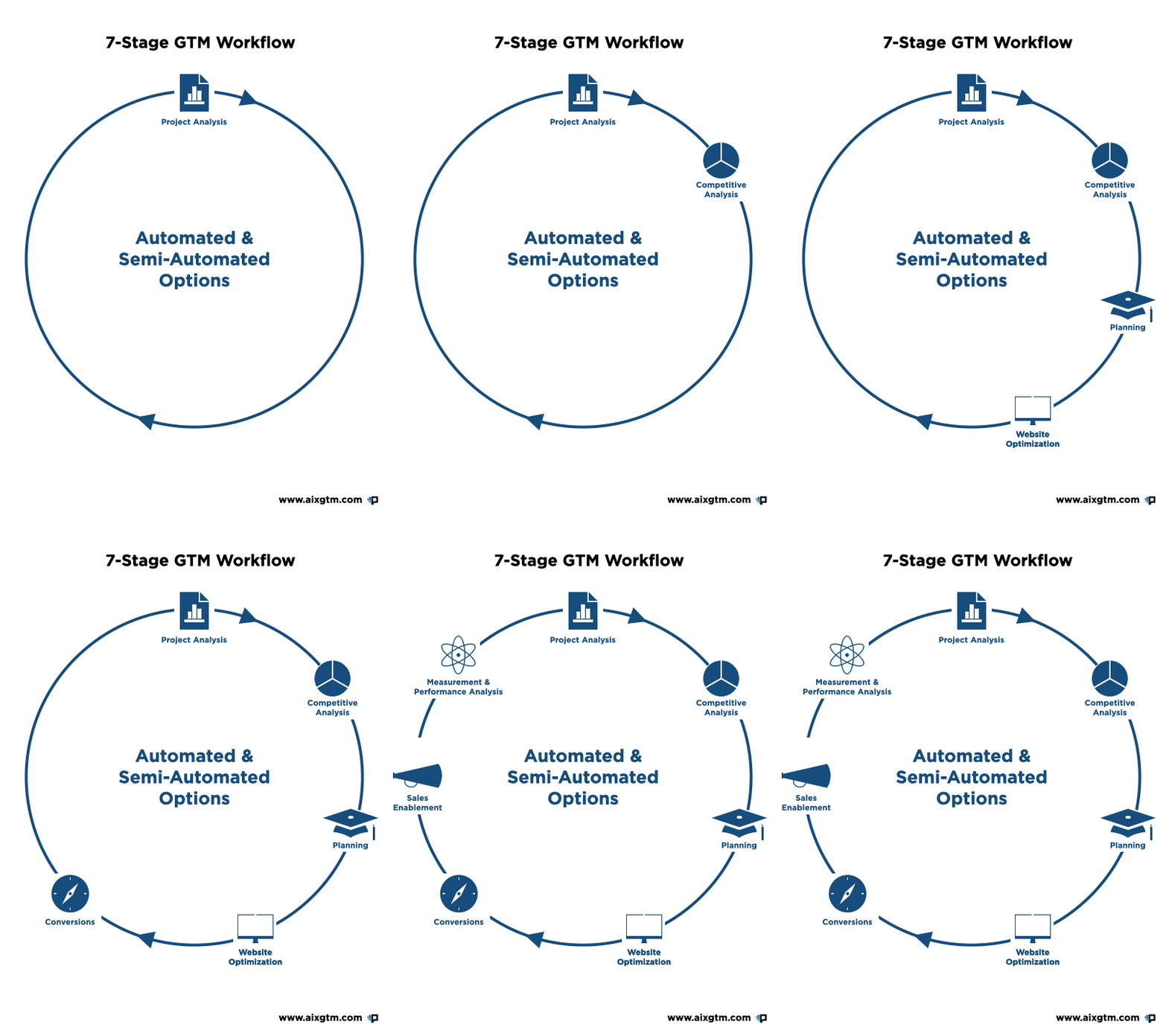
AIxGTM guides each project through a 7-stage GTM workflow so you can move from analysis to execution with structure, speed, and context intact.
Review goals, market context, and competitive landscape to surface strategic findings and next-step priorities.
Clarify positioning, differentiators, features, benefits, and product strengths before building campaigns.
Generate messaging frameworks, campaign direction, channel strategy, and execution-ready planning assets.
Improve copy, landing pages, and SEO/GEO opportunities to make your site clearer, stronger, and easier to convert from.
Website messaging use case →Create funnel content for awareness, consideration, decision, and retention without losing alignment to audience or strategy.
Produce battle cards, collateral, and sales-ready assets, with interactive role-play support for practice and refinement.
Run Check Progress every 30 days: it cites your project's own GA4, Google Ads and social media data — findings, coverage, and limitations — and ends in retain, adjust, or stop recommendations for what's running.
Monitoring workflow →In practice, this means you can quickly generate strategic analysis, planning direction, website recommendations, funnel assets, and sales support materials from the same connected project context.
And the loop doesn't stop at day 90: plan the next 90 days while the current calendar runs. Approving the successor schedules it, and it takes over automatically on its start date — a clean cutover with no gap between quarters.
The 7-stage workflow is the backbone, but these capabilities make the difference between generic AI output and work you can actually use. Explore specific use cases to see them in action.
Run AI-powered focus groups with up to five target audience profiles, brainstorm sessions with a four-role creative team, one-on-one target audience profile role-play for message testing, or copy checks where all your target audience profiles evaluate content simultaneously. Each session draws on your project context and target audience profiles.
Connect different social media accounts to different projects to schedule and post content. Or export it as Word documents, text files, PDFs, or directly into Google Docs. The export system strips AI conversational framing, preserves formatting like tables and headings, and classifies content for Schema.org structured data to support SEO & GEO.
Turn your current product, audience, marketing plan, messaging matrix, and supporting GTM artifacts into a Client, Board, or Investor pitch deck. Each version is structured for that audience's decisions and is available as a presentation-ready PDF or editable PowerPoint.
Your content requests are matched to our time-tested library of b2b and b2c prompts via a hybrid scoring model that combines semantic understanding, keyword matching, and fuzzy matching with boosts for prompt quality and channel fit. This surfaces the right prompts for creating right content for your project, product and target audience profiles.
Share a project as a managed copy so your team or clients can run day-to-day content creation while you keep control of the strategic foundation. Update the marketing plan or content calendar once and everyone's workspace stays in sync. When someone is ready to own a project outright, hand it off with Transfer Control.
Explore Team ProjectsBudget drafts use the right currency. Target audience profiles reflect regional context. Recommendations adapt to local market conventions.
United States
USD
United Kingdom
GBP
Canada
CAD
Australia
AUD
Currency, regional conventions, and target audience differences are applied automatically based on your project region setting.
Most AI tools start every task from zero. AI x GTM builds a compounding knowledge layer where each stage makes the next one sharper. See how this compares to alternatives.
Every deliverable is assembled from your actual project state. A budget draft draws on your marketing plan, target audience profiles, and content strategy. A UI/UX analysis incorporates distilled persona preferences and all planning artifacts. Nothing is templated.
Content concepts are scored across all your target audience profiles using a mathematical voting algorithm, producing universal themes relevant to everyone and niche themes important to specific audiences. Recommendations reflect your targets, not generic best practices.
The monitoring system learns from your feedback. Accepted recommendations are boosted in future runs, rejected ones are suppressed. Past outcomes are stored with vector embeddings so the system can identify what worked in similar situations before.
B2B and B2C projects receive different funnel structures, stage labels, target audience profile metadata emphasis, and prompt libraries. This is not a surface-level toggle. It adapts the workflow, content ranking, and deliverable structure throughout.
Fast GTM Output
Turn the inputs you already have into practical GTM work your team can review, refine, and use.
7-Stage Workflow
Real Output
These 12 PDFs came out of a single GTM project, in the order the workflow produces them — nine connected strategy and execution artifacts, followed by modular Client, Board, and Investor pitch-deck libraries. Each inherits the same context. Download any of them, no email required.
Foundation
The starting point. Project goals and strategy settings that lay the groundwork for everything downstream, and establish the baseline that ongoing analysis measures against.
PDF · 14 pages · 0.6 MB
Market Intelligence
Market context around the product: headwinds and tailwinds, demand drivers, the competitive set, and buying-committee dynamics — plus a feature-to-benefit map and the guardrails that keep downstream claims honest.
PDF · 15 pages · 0.6 MB
Planning
A phased launch plan with a strategic core, 30/60/90 objectives, channel priorities, owners, and the KPI baseline every later artifact is measured against.
PDF · 31 pages · 1.4 MB
Planning
Jobs-to-be-done rows pairing each buying job with its pain, the features that answer it, the message, the proof required, and the CTA.
PDF · 8 pages · 0.6 MB
Planning
Segment families and buying committees with themes, example audiences, best-fit ICPs, and the validation steps before spend scales.
PDF · 66 pages · 3.8 MB
Conversions
The marketing plan translated into funnel-stage content: inherited strategy, themes, asset inventory, and a prioritized backlog with disposition notes.
PDF · 41 pages · 1.4 MB
Conversions
A week-by-week calendar deck: cadence against target by channel, phase breakdowns, and per-item status from planned through accepted.
PDF · 33 pages · 1.0 MB
Planning
An annual budget with top allocations, per-line rationale, effort levels, and the market context and assumptions behind each number.
PDF · 29 pages · 1.5 MB
Conversions
Audience-by-audience paid structure with message hooks, recommended offers, best-fit channels, launch prerequisites, and priority ranking.
PDF · 68 pages · 3.1 MB
Pitch
A complete modular slide library for a client presentation, built from the same RelayOps strategy. Choose and reorder the audience, positioning, channel, funnel, roadmap, KPI, and next-step slides the meeting needs.
PDF · 59 pages · 2.3 MB
PowerPoint · 58 slides · 1.8 MB
PDF and PowerPoint were generated together from the same project run. Page and slide counts can differ as each format reflows dense content.
Pitch
A source-backed Board slide library that reframes the GTM work around the thesis, market opportunity, target segments, roadmap, resources, KPIs, governance, risks, and decisions. Select and reorder the slides needed for the discussion.
PDF · 63 pages · 2.4 MB
PowerPoint · 60 slides · 1.9 MB
PDF and PowerPoint were generated together from the same project run. Page and slide counts can differ as each format reflows dense content.
Pitch
A leaner modular Investor slide library connecting the problem, solution, product, market, differentiation, target buyer, and GTM motion, with clearly labeled milestone, pro forma, team, advisor, and use-of-funds templates to complete.
PDF · 30 pages · 1.5 MB
PowerPoint · 30 slides · 1.0 MB
PDF and PowerPoint were generated together from the same project run. Page and slide counts can differ as each format reflows dense content.
Start a project, run the workflow, and see how connected context changes the quality of what you produce.